The mom flu

Once, when I was about 14 I had a sinus infection so severe that I nearly blew my left eye out.

To this day, I have to close my eyes tightly when I blow my nose so as not to accidentally launch my left eye across the room.

It occurred to me over the past several days, eyes closed, blowing furiously into a Kleenex, that I used to be really good at being sick.

As a kid I was sick all the time. I had coughs, fevers, pink eye, strep throat and chicken pox. I even got shingles when I was 13 — a special virus reserved for the elderly — that traced perfect loop-de-loops around my teenaged back.

But at some point it all stopped and I got cocky. My life is a germ factory, and I walk through it daily in short sleeves; my sick offspring literally sneeze into my open mouth and I wake up the next morning without a sniffle.

I rarely get sick, and now I’m out of practice.

Man Flu has its own Wikipedia page, and just recently, Dr. Robert H. Schmerling posted results of a scientific study conducted to determine if this condition is legitimate — if men actually experience more acute flu symptoms than women.

There is no similar Wikipedia page or Harvard study for the Mom Flu, so I feel qualified to discuss the differences between them, and I’ll do so by drawing upon zero actual research, and pure anecdotal evidence. Here is my conclusion: Women rarely give themselves permission to be sick.

Men are no better at math than women. They are no better at driving, at comedy, or at managing money. One only has to turn on the news to recognize that they’re also not that fabulous at running countries.

But they are great at being sick, and most of the women I know (sorry for generalizing ladies) are terrible at it.

This Mom Flu found me at home, alone, on my living room couch, on a cold Tuesday morning, confused and anxious about what was going on.

“What does a sick person even do,” I asked my dog.

He suggested a rousing game of fetch or a trip to the dog park, but there wasn’t enough Kleenex in the world to make that possible, so instead I washed the dishes, cleaned the kitchen, tidied up the boots by the front door, started a load of laundry and took out the recycling. Then when I felt I had “earned” some down time, I made tea and sat on the couch.

Tea done, I got up, put the mug in the sink, and looked around.

“What now,” I kept wondering, as the minutes ticked by on my first official sick day in over a year, completely aware that I was failing, and feeling crummy about it because I hate being bad at shit.

I turned on the TV but it seemed noisy and out of place during the day.

So I folded laundry.

Then I tried to nap, because that’s what I tell my kids to do when they’re sick.

But instead I sat on my bed and stared at my dog, who I eventually took for a walk.

Sick Day No. 1 was over, and I’d accomplished about 20 minutes of productive rest time.

I’ve got a Mom Flu. I’m out of practice, and it’ll take a lot longer than the length of the average flu to figure out how to grant myself permission to relax.
A social life, curated

Social media is such a lie, and I am such a liar.

It has been nine months since I posted to my blog, and it’s not because I ran out of things to say.

Ask anyone and they’ll tell you that I have two super powers, and one is never running out of things to say, ever. In fact, I can carry on both sides of every conversation without even pausing for breath.

I talk everywhere, and to anyone. Trying to get some work done? Big deal! I had a hilarious thought! Just about to make an important phone call? Yeah, but wait until you hear this!

I’ve always had a lot to say, but what I say, and what I share (especially on social media) has always been carefully curated. The moments in which I’m absent or silent are the moments that I don’t have the capacity for curating. If I had posted to my blog three or four months ago I would have shared thoughts and feelings that I would have immediately regretted.

I would have risked opening myself up to sympathy, pity, and criticism at a time when judgement was the last thing I needed, and pity would have driven me insane.

And I’m not that brave.

So I stopped writing because I didn’t want to run the risk I’d write something I’d regret — something I couldn’t delete.

But then I looked back over the past several months of my social media posts, only to realize I had been talking. I had been talking quite often, but the conversations I shared were so carefully manufactured that they were almost outright lies.

“Look at my life,” those posts cried out, “it’s full of sunny days, big smiles, fitness, family, friends, vacations, and very merry Christmases.”

Truthfully? That’s garbage. This fortieth year has been the most difficult of my life.

Brick by brick, I’m putting myself back together. But the trauma this year has brought has forever changed the way I am, the way I see myself, the world, and probably the way I write.

The lies we tell on social media aren’t intentional, or malicious. We’re all just constructing the stories we want to read. The stories aren’t always true, but we want them to be, we can imagine they are, and there’s comfort in that.

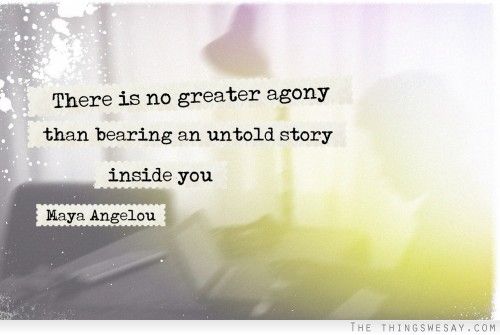
Here’s to 2019. A year of great stories, and greater honesty, openness and bravery. And to greater recognition that behind every perfect and hilarious social media post there is someone with an untold story who is working very hard to build herself back up again, brick by heavy brick.


Rainy Sunday reading

My perfect rainy Sunday involves a great book, a fireplace, a soft blanket and a hot cup of coffee.

Oh, and a clean house that smells of pie, and children who are playing together (with educational toys), quietly.

I can’t manage most of this — except the coffee and the book, and usually the coffee is lukewarm by the time I actually get to sit down and drink it. I can almost always carve out a small space in each Sunday for reading, but at this stage in my life, the books I read have to meet certain criteria.

For starters, they can’t be overly complicated. There was a time in my life when I expected a lot from literature. I devoured classics, and poured over Oprah’s book list. These days? I need books that take me away but don’t ask much of me in return.

Oh, and I’d prefer if they don’t make me cry. There’s enough sadness in the world. I’ll come back to the classics and the books that soak up my sobs eventually, but these days I need escape.

So, if escapist fiction — often with a historical bent — with the occasional bit of dystopia thrown in for good measure is up your alley, then read on to find out what I recommend, and I’ll do my best each rainy Sunday to offer a few other suggestions.

(Note: I live in a semi-arid region, so there aren’t as many rainy Sundays as one might wish for)

The catch? You have to share your recommended reads with me. I read a lot, and quickly. I’m always running out of books, so the more recommendations the better.

What I’m reading now

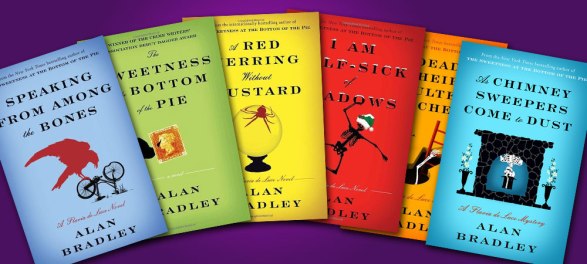
The Flavia de Luce series by Alan Bradley (books 1 through 9)  flaviadellucebooks

“It was one of those glorious days in March when the air was so fresh that you worshipped every whiff of it; that each breath of the intoxicating stuff created such new universes in your lungs and brain that you were certain you were about to explode with sheer joy; one of those blustery days of scudding clouds and piddling showers and gum boots and wind-blown brollies that made you know you were truly alive.” 
Speaking from Among the Bones, Flavia de Luce, No. 5

A friend of mine introduced me to this series. It turns out that despite the fact my friend is way smarter than me, with many letters after her name, she and I have a similar taste in reading. This knowledge makes me feel way smarter than it should.

But Flavia is truly enchanting, and I’m so glad we met. Set in 1950, 11-year-old Flavia is finding her way through the world out of her home base of Buckshaw, a rambling old English mansion. Her mother died when she was a year old, her older sisters either ignore her or are terrible to her, and her father is absent. She’s raising herself under the sometimes watchful eyes of Dogger, her family’s butler who suffers from PTSD. Her best friend is Gladys, her bicycle.

Oh, and did I mention that Flavia has a passion for poisons, and also solves murders?

Alan Bradley is a brilliant writer, one I wish I had discovered sooner, and I’m so excited for you to get to know Flavia if you haven’t already.

The Timothy Wilde Series by Lyndsay Fayelyndsay faye timothy wilde trilogy

The Gods of Gotham, Book 1
Seven for a Secret, Book 2
The Fatal Flame, Book 3

I can’t remember who recommended The Gods of Gotham to me, or whether it was one of those books that just kept popping up on my recommended reading lists, and I eventually just bit the bullet and bought it, but however it happened, I’m grateful.

The Gods of Gotham, set in the 1840s, introduces Timothy Wilde, the best, yet most reluctant, copper star on New York City’s inaugural police force. It’s dirty, and twisted. I pride myself on being a bit of a plot sleuth, able to figure out what’s going to happen before the author shows me, but there are so many twists and turns and gritty bits in this book that I was completely taken by surprise. Wilde is among the only decent humans that Faye reveals, in her exceptionally well-researched period drama.

These are my recommendations for today, what are yours?

Bringing home the (dog) baby

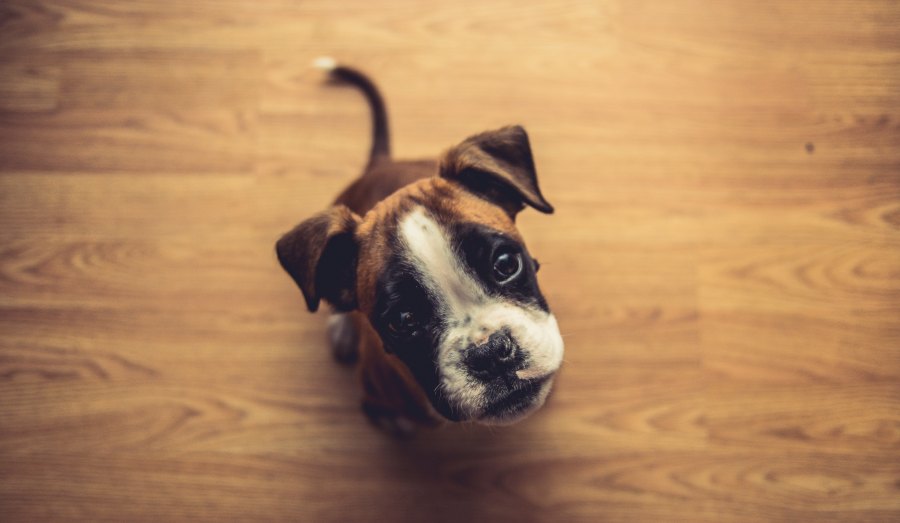
This week our family welcomes its first puppy.

For years I’ve rolled my eyes at the suggestion that raising a dog is similar to raising a child. Often, this comparison comes from people who don’t have children, making scoffing a requirement.

But, having spent the past several weeks planning to bring a puppy into the home, I’ve come to realize that maybe — just maybe — I’ve been too quick to dismiss the similarities. There are a few.

Consider upfront costs, for example.

Dog babies, much like human babies, require a ton of stuff, and as a result, are really, really expensive. My dining room table is buried under bags of dog food, dishes, treats, toys, bedding, crates (one for home, and one for travel), and an endless supply of puppy potty training essentials.

And nobody — not a single person — threw me a puppy shower, so I’m on the hook for all of it.

Then there are the late nights spent coming to terms with the fact that I don’t know what I’m doing and I’m bound to screw it up and raise an asshole dog that sniffs crotches, jumps on children, pees everywhere, barks at everything and eats cats and postal workers.

As motherhood approached, I spent many nights tossing and turning, and staring at the ceiling fretting about the same things — minus the crotch-sniffing and cat-eating, of course.

And let’s not forget the unsolicited and often conflicting advice.

“You must follow Cesar Millan’s method, it’s amazing.”

“DO NOT follow Cesar Millan’s method. It’s terrible.”

“Don’t use pee pads.”

“Do use pee pads.”

“You must clicker train. Immediately.”

“Do NOT give him a human name. He is NOT a human.”

When this advice is launched at me, I can’t help but think back to the unsolicited and often passive aggressive advice I fielded during my advent into motherhood, some nine years ago.

“DO NOT give him a soother. You’ll never break him of it.”

“Disposable diapers are great for people who hate the Earth. Do you hate the Earth?”

“No screen time. EVER. Until he’s at least eight.”

“Keep him rear facing until he reaches puberty.”

“Bottle feeding is an option. If you’re terrible.”

“DON’T swaddle him.”

“DO swaddle him.”

“DON’T let him cry it out. EVER!”

“Jeez, just let him cry it out already!”

When I was growing up everyone had dogs, and all any dog needed was a collar, a leash, a bed, a bowl and a belly rub or two. Instead of pee pads and poop bags we had newspapers and shovels. Dogs licked plates, ate scraps, chewed ham bones, and gobbled whatever kibble was on special that week.

Somehow, even without all of the gadgets and canine behavior modification methods, dogs were amazing. They protected us, loved us, and we returned the favour.

Dog ownership has become riddled with pitfalls. The stakes are higher, the expectations greater.

But I’m convinced that, as with raising children, sometimes the simple things matter more than the gadgets and the gimmicks; simple things like consistency, routine, encouragement and praise.

There. Now it’s your turn to roll your eyes.

Random acts of compassion

The wind has a bite to it, and sharp teeth, too. I slam my car door before another gust hits, crank up the heat, and nose out of the parking lot with a million things on my mind, and too few hours in the day.

The light turns red and I curse. I’m already late, and this light is so damn long — it’s the longest light in the city. The light’s not triggered by traffic, but I roll my car forward anyway, seething with impatience.

Out the passenger window I watch as a woman wearing a long blue scarf leaves the bank, stops, turns, and walks back the way she came, pausing in front of a bundle of blankets on the sidewalk.

The bundle moves, and a woman’s face peeks out, nearly camouflaged against the mud-coloured siding of the bank.

The woman in the blue scarf crouches down, leans in and begins talking. I can’t hear her. I so badly wish I could hear her. She’s smiling and nodding her head. The woman she speaks with looks up.

The woman in the blue scarf reaches up and unwinds it, grabbing hold of it tightly in the wind. She leans forward and wraps the blue scarf carefully over the shoulders of the woman on the sidewalk. The scarf, still warm, probably smells of perfume.

The woman in the blankets puts her head down, wraps her hands around her knees, and starts to cry. I can tell she’s crying by the rise and fall of her back, by the way her shoulders shake. That’s the way my children look when they cry. That’s the way I look.

The woman who gave the scarf, leans forward, takes her hands, and holds on tight. The light turns green, and I drive away, staring at the pair on the sidewalk in my rearview mirror until I turn a corner.

**

Cool, with a taste of spring, it’s light jacket weather. I’m jogging my usual route, and I’ll be home in half an hour – just in time for dinner.

I see them at a fork in the path and they make an odd trio. The older man stands several feet away, hands in his pockets, running shoes scuffing the ground as though anxious to get moving. Off to his left stands an elderly grandmother-type with a leashed Chihuahua perched on her shoulder like a bug-eyed, panting parrot.

She stands and smiles down at a boy — a teenager, by the size of him. His back rests against a light post; his face is hidden inside his jacket, which is zipped so high only his mop of black hair pokes through. He’s slumped forward, arms crossed over his knees. She stands at his side, chatting, and looks up to smile at me, waving me on as I slow down. The boy needs help. He needs someone to notice him, to speak to him, to care about him. The woman with the Chihuahua smiles at me as if to say, “it’s OK. I’ve got this. You go.”

Weakness is walking away from people who need help. It’s hard to stop, and harder still to know what to say, or do, being more afraid of saying and doing the wrong thing, than of doing nothing at all. I’m ashamed to admit having walked away.

Perhaps someday I’ll have a blue scarf to give, and be brave enough to be so compassionate.


A message from the universe

There are a number of etiquette rules one must follow while using a public restroom, and those rules are compounded when that public restroom is in your place of work, and shared with your colleagues.

Rule No. 1: Double flush. If/when you absolutely must go No. 2 while at work, get rid of the evidence as best you can. Public sanitation systems have never been so sophisticated — take advantage of them!

Rule No. 2: Wash your hands. It’s the right thing to do.

Rule No. 3: Refrain from taping inspirational messages and motivational thoughts to the toilet seat.

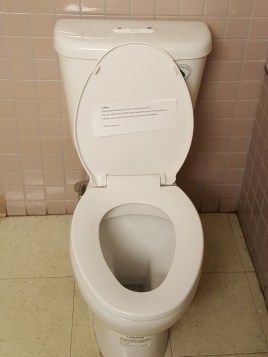
 I arrived in the ladies the other day to find that The Universe had gone out of its way to type out a note, print it, and tape it crookedly to the underside of the toilet lid. The note read:20180306_205454_resized

Today…
Give thanks that your life is exactly as it is.
Decide that 2018 will be the happiest year of your life yet.
Follow your heart and instincts down new paths.
– The Universe

“Hey, thanks, Universe, but I’m going to have an accident, so before I follow my heart, I’m going to follow my bladder,” I thought to myself.

Job done, hands washed, I went back to my office and considered this message. It got under my skin.

This wasn’t the first time I’ve stumbled upon something unpleasant in the bathroom but it was the first time The Universe had attempted to connect with me in this space. There’s usually always some messaging in public bathrooms. Sometimes, the messages are simple, “WASH YOUR HANDS,” and, “OUT OF ORDER.” Sometimes, the messages are more complicated. Last month I learned how to identify someone in the midst of an overdose, and where to inject Naloxone for best results, all while going pee.

But in this place of bathroom business, I’m not open to messages from The Universe; I am here because I have a job to do. Sometimes, that job is unpleasant. Always, that job is brief. In this space, often scented with the efforts of previous occupants, I try not to linger. I barely breathe; there’s no time to give thanks, follow my heart or consider new paths.

Put more bluntly, if The Universe were a person, it would be standing on my doorstep, handing me a Watchtower pamphlet while my dinner boiled over on the stove.

Your timing, Universe, was extremely poor.

There are other places in which I’d be more receptive to The Universe’s machinations. The doctor’s office for instance, as I’m captive here. When I’m not staring at my phone, I’m usually just eyeing up posters of anatomy, which are educational, but if The Universe opted to post its message beside the male reproductive system, I’d probably spare it a glance.

The Universe may also wish to reconsider method of delivery. Paper and tape might have been OK years ago when there weren’t so many other messages competing for our attention, but these days, it would be wise to investigate podcasts, maybe run some promotions through social media, or even try to crack its audience through a clever billboard, or a nicely situated bus stop bench.

All of these options would be more permanent and less irritating than the paper and tape, which is easily chucked into to the trash, or wadded up to use in place of paper towel. Or worse.


Easy for you to say

I’m currently in a long-term relationship with words. We’re ridiculously happy together — it’s disgusting, really. When we’re alone snuggled inside delicious-smelling pages, I’m oblivious to the world outside my window.

But like any relationship, we’ve hit the occasional rough patch. And to my great shame, we often quarrel publicly, as was the case earlier this week.

“What’s the name of that local theatre company,” a colleague asked those of us gathered around a boardroom table during a routine meeting.

I knew what was about to happen as soon as I opened my mouth. I knew it, because it’s happened so many times before. This is one mistake I will never learn from.

“Shim-ear-ah,” I answered, the last syllable of the gibberish nonsense word fading away.

My colleague looked up from her laptop, and caught my eye; the woman to her left simultaneously glanced up from her phone and grinned; the millennial to my immediate right put down her mason jar/water bottle and choked on an ill-timed sip.

“You mean Chimera (kai-mira), right,” the question-asker responded with a smirk. We all laughed; I laughed loudest of all.

For someone who calls herself a writer, I manage to mess up my mother tongue regularly. I can see the word perfectly in my mind. I can spell it. I can even give you the definition and provide you with a passable sketch. But until this day, I’d managed to avoid saying chimera out loud.

Unlike pedagogy — a word I didn’t encounter much until I began poking my nose into academia. Pedagogy, you’ll note, doesn’t rhyme with ‘doggy,’ which is something I discovered on my first or second day on campus.

I’ve been involved in this tumultuous relationship with words my whole life. We fight, we make up.

There I was, 11 years old, out for a fancy dinner with my family and dressed to the nines in my red and white polka dot dress with the shoulder pads. It was my mom’s birthday, and I was on my best behavior when I looked up and asked her if I could please order “whores-de-voors?”

The answer was no, we weren’t made of money, and also, we call them “hors d’oeuvres.”

Many dates that start with hors d’oeuvres, end with lingerie, which I correctly supposed meant fancy underpants based on the sassily attired mannequins in the shop window, but I always thought it sounded more like a tasty pasta dish, especially since I pronounced it “ling-gear-ee.”

Proper names have also been known to trip me up, and I apologize in advance to any of my Irish friends.

I had a mild crush on Sean (Seen) Astin as a child; he was cute in the Goonies. Then there are the fictional characters I encountered, the Seamus’s (Seemus’s), Yvonne’s (Why-vown-ee), any random colonel (there is no r in this word!), and, of course Hermione (Her-mee-own). I even managed to screw up Reggie’s name, you know, Archie’s friend? I pronounced it with soft gs, similar to how I mispronounced digest (dig-est).

The letter G is tough to navigate — take paradigm and prodigal for example. The safest option is to avoid these words altogether by using 15 other words to describe their meaning. This is advice I wish I had taken earlier this week, thereby avoiding the whole chimera debacle.

I’ve been subdued since chimera, trying my best to learn from my mistake, and move on. Words and I have been a bit distant — we need a bit of space, perhaps, a little breathing room, and some Netflix.